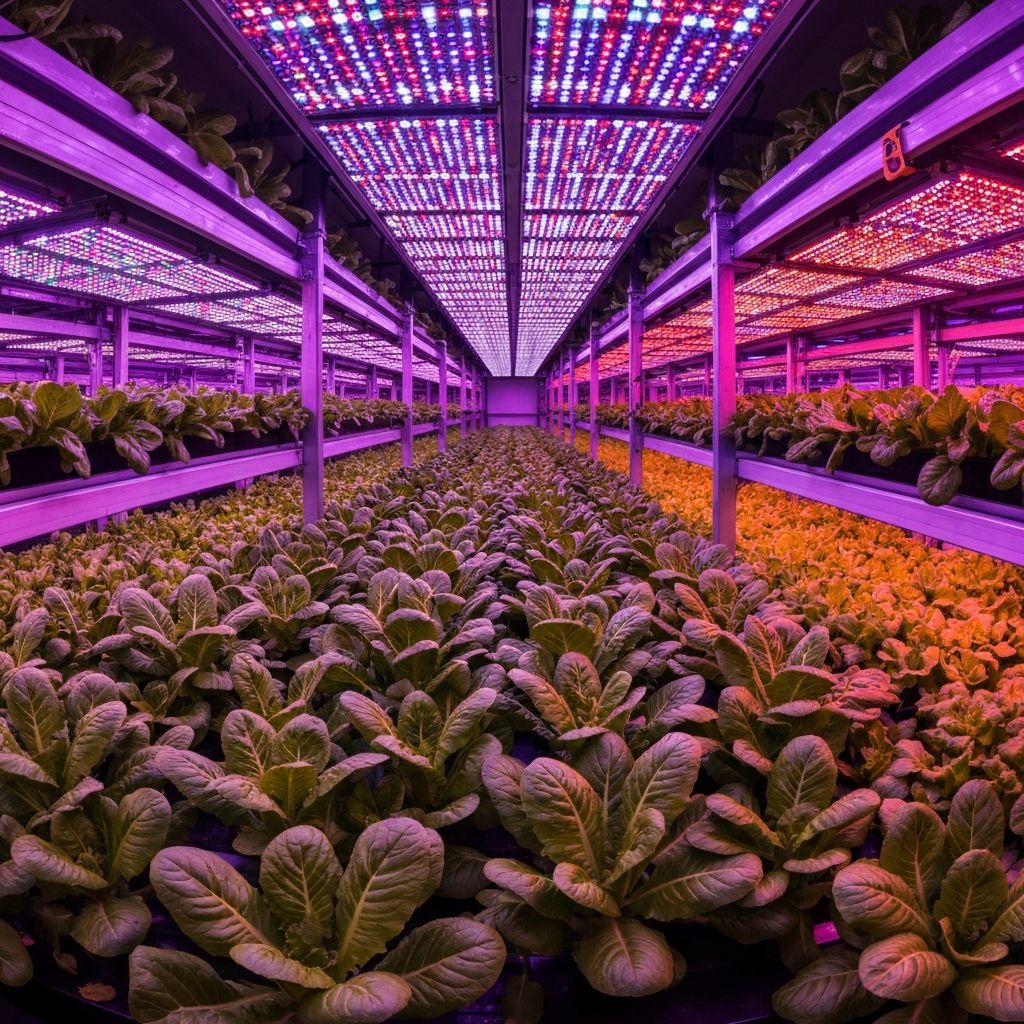
Light is the engine of plant growth. Understanding how different wavelengths affect plant development allows you to optimize your LED setup for maximum yield and quality.
The Light Spectrum Explained
Plants use light primarily in the 400-700nm range, known as Photosynthetically Active Radiation (PAR).
Blue Light (400-500nm): - Promotes vegetative growth and compact, bushy plants - Essential for chlorophyll production - Helps regulate stomata opening - Best for leafy greens and herbs
Red Light (600-700nm): - Drives photosynthesis most efficiently - Promotes flowering and fruiting - Encourages stem elongation - Essential for fruit-bearing plants
Far-Red Light (700-800nm): - Triggers shade avoidance response - Can promote faster flowering - Use sparingly to avoid stretchy plants
Optimal Spectrums by Crop
Lettuce & Leafy Greens: - Ratio: 3:1 Red to Blue - Blue promotes compact growth - Moderate intensity (200-400 PPFD) - 14-16 hours daily
Herbs (Basil, Mint, etc.): - Ratio: 2:1 Red to Blue - Higher blue for essential oil production - Medium intensity (300-500 PPFD) - 12-16 hours daily
Tomatoes & Peppers: - Ratio: 5:1 Red to Blue during flowering - Higher red promotes fruit set - High intensity (400-600 PPFD) - 12-14 hours daily
Understanding PPFD and DLI
PPFD (Photosynthetic Photon Flux Density) measures light intensity in micromoles per square meter per second (μmol/m²/s).
DLI (Daily Light Integral) is total light received per day. Calculate: PPFD × hours × 0.0036 = DLI
Target DLI by Crop: - Lettuce: 12-17 mol/m²/day - Herbs: 15-20 mol/m²/day - Tomatoes: 20-30 mol/m²/day
LED Setup Best Practices
1. Hanging Height: Start 12-24 inches above plants 2. Even Coverage: Use multiple lights for uniform distribution 3. Light Schedule: Use timers for consistent photoperiods 4. Heat Management: Ensure adequate ventilation 5. Dimming: Start seedlings at 50% intensity
Signs of Light Problems
Too Much Light: - Bleached or yellow leaves - Curling leaf edges - Slow growth despite good conditions
Too Little Light: - Leggy, stretched stems - Pale green or yellow leaves - Slow growth and small leaves
Pro Tips
- •Full-spectrum LEDs are best for beginners
- •Measure light at plant canopy level
- •Raise lights as plants grow taller
- •Consider supplemental green light for plant inspection
- •Replace LEDs every 3-5 years as efficiency decreases